London, March 2026 — When eight London households were asked to estimate how many meals they had eaten out in the previous month, the average estimate was 6.2. The actual figure, drawn from the logs maintained during the observation period, was 14.8. The gap between what people believe about their eating-out frequency and what their record shows is, itself, a pattern worth examining.
The Occasion That Became the Norm
Eating out — at restaurants, cafes, fast food venues, and the expanding category of food-hall and street-food markets — was, for the generation immediately preceding the current adult population, an occasion. It marked a birthday, a celebration, a work lunch of some significance. The domestic cooking week was the baseline; the restaurant meal was the departure.
Among the eight households observed for this record, none operated on that model. The baseline, for all eight, was a combination of home cooking, delivery, and eating out — each element present multiple times per week, with no single one constituting the norm. Eating out was not an occasion. It was a mode of eating, interchangeable with the others depending on time, energy, and proximity to food venues.
This shift — from occasion to mode — has practical implications for portion distortion. When eating out is an occasion, the diner's internal reference for what constitutes a normal portion is set by home cooking. The restaurant portion registers as larger than usual, and the excess is noted. When eating out is a mode, no such calibration occurs. The restaurant portion, encountered multiple times per week, becomes the reference point. Home-cooked quantities begin to seem, by comparison, insufficient.
What the Logs Recorded: Fourteen Meals in a Month
The 14.8 average monthly external eating events across the observed households broke down differently than expected. The largest category was not restaurants. It was purchased lunch — a sandwich, wrap, or prepared food item bought from a cafe, supermarket, or coffee shop and eaten at or near the point of purchase. These events accounted for 6.3 of the 14.8 average, and they were the category most likely to be excluded from respondents' self-estimates.
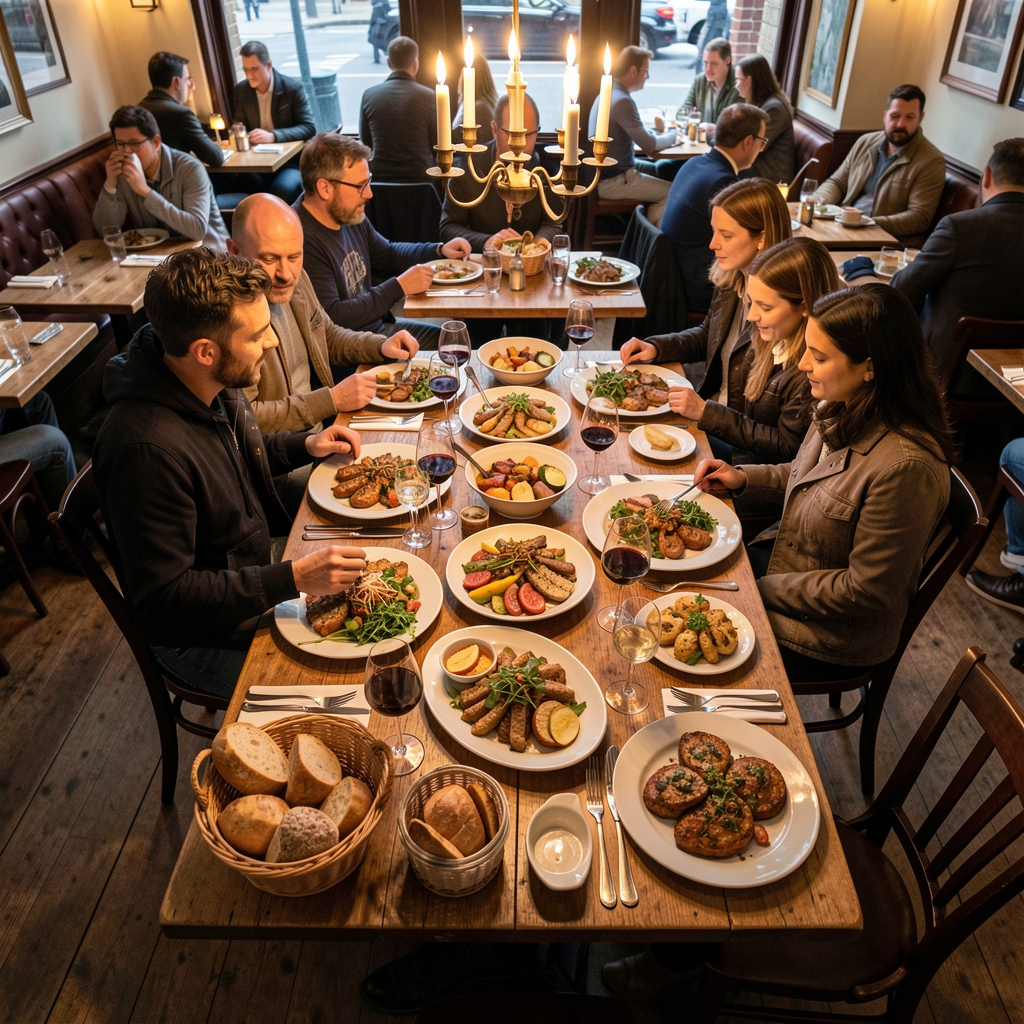
The second-largest category was what respondents termed "proper eating out" — a sit-down meal at a restaurant, pub dining room, or similar. These averaged 3.1 per household per month. The third category was fast food or quick-service restaurants, averaging 2.8. The fourth was food-delivery orders consumed at home, averaging 2.6. This category occupied an ambiguous position in respondents' mental accounting: it was eaten at home, but it was not home cooking. Several respondents had not included it in their estimates at all.
The fast food frequency figure — 2.8 occasions per month — represents a significant volume when cumulative caloric and nutritional content is considered. Standard fast food meals across UK chains carry average salt content of between 2.1g and 3.4g per meal, alongside refined carbohydrate content in the bread, coating, and potato components that places them consistently in the high-end range under standard nutritional evaluation. At 2.8 occasions per month, the average household in this record received approximately 11 high-salt, high-refined-carbohydrate external eating occasions per quarter from fast food alone.
Portion Distortion: The Restaurant Calibration Effect
The portion distortion problem documented in nutritional research takes a specific form in frequent external eating. It is not simply that restaurant portions are large — though many are. It is that repeated exposure to restaurant-scale portions recalibrates the diner's internal reference for adequacy. The recalibration is silent and gradual, which is partly what makes it difficult to recognise.
Among the observed households, this was most clearly visible in the four households with the highest external eating frequency (above 18 meals per month). When asked to estimate what they would consider an adequate portion of pasta at home, these households described quantities that were, on average, 35% larger than what the same households would have described as adequate eighteen months earlier, based on retrospective accounts. The comparison is imprecise, but the direction is consistent with the portion recalibration literature.
Weekend indulgence patterns contributed a specific dimension to this picture. Saturday and Sunday external eating events showed consistently larger food orders than weekday events — more courses, larger portions selected, higher incidence of sides and desserts. This is an expected weekend effect, documented across European eating behaviour research. What the logs added to this picture was the Monday recalibration: in five of eight households, Monday's home-cooked meals were reported as feeling "not quite enough" despite containing quantities that, by nutritional analysis, met or exceeded standard caloric requirements. The weekend reference point was exerting influence on weekday experience.
"The portion hasn't changed. The expectation has. That's the part the scale doesn't measure."
The Cooking at Home Observation
The benefits of cooking at home, in nutritional terms, are extensively documented. The relevant question for this observational record is not whether those benefits exist but what specifically makes home cooking decrease as external eating increases — and whether the two are causally related or simply correlated through a third factor, such as time availability or cooking confidence.
Across the eight households, the primary stated reason for choosing external eating over home cooking was time, cited in 71% of the eating-out decisions logged during the observation period. The second most frequently cited reason was convenience (not wanting to plan and shop), at 18%. The third was preference for a specific food type not easily reproduced at home, at 8%. Cooking ability was never explicitly cited as a barrier, though two households acknowledged during the structured conversation element of the observation that they had not cooked more than three distinct dish types in the previous month.
The gradual dietary improvement literature on home cooking identifies a consistent enabling factor across households that successfully increase home cooking frequency: the reduction of decision load at the point of preparing a meal. Households that maintain a small repertoire of familiar, achievable meals and keep the relevant ingredients available show higher sustained home cooking rates than those that approach meal preparation as a creative or research exercise. The kitchen that contains the ingredients for six reliable meals is used more often than the kitchen stocked for ambition.
Salt, Sugar, and the Restaurant Transparency Gap
In the home kitchen, the cook has, in principle, full visibility of what goes into a meal. In practice, this visibility is partial — sauces, stock cubes, condiments, and marinated proteins carry significant salt and sugar content that is not always interrogated at the point of cooking. But it is substantially greater than the visibility available to a diner in a restaurant or cafe, where no nutritional information is ordinarily displayed or provided on request.
The high-salt food habits documented across the observed households were, in proportional terms, more attributable to external eating than to home-cooked meals. When the logs were analysed by source — home-cooked versus external — external eating occasions accounted for an estimated 58% of total salt intake across all households, despite representing only 40% of eating occasions. The salt density of external meals was consistently higher than that of home-cooked equivalents.
Hidden sugars showed a similar pattern, particularly in purchased-lunch categories. The sauces, dressings, and condiments on cafe-prepared sandwiches and wraps contributed sugar quantities that respondents were unaware of and would not have chosen to consume if given the information at the point of purchase. This is not a question of individual negligence; it is a structural feature of the external eating environment in the UK, where the obligation to display nutritional information applies only to packaged goods sold in retail, not to prepared food sold in food service.
What Eight Households Recorded Over Four Weeks
At the close of the four-week observation period, five of eight households reported that the log had changed their perception of how often they ate out. Three reported that this change in perception had already influenced their behaviour in some way — specifically, moving one or two external eating occasions per week toward home-prepared alternatives. The other two reported awareness without yet having made any adjustment.
The three households that made adjustments during the observation period described similar reasoning: the log made visible a pattern they had not intended to establish. They had not decided to eat out 15 times in a month. It had accumulated from individual decisions, each of which seemed reasonable in its specific context. Seeing the cumulative figure — and, alongside it, the estimated cumulative nutritional profile — produced a response that general nutritional guidance had not.
Cooking at home benefits, in this framing, are not primarily a question of skill or time. They are a question of visibility: what the cook can see about the food they are preparing, and what the habitual external eater cannot. Gradual dietary improvement, in the cases where it occurred within the observation period, began not with a change in cooking frequency but with a change in the accuracy of self-knowledge about eating frequency.
- – Households underestimated their external eating frequency by an average factor of 2.4 — estimating 6.2 monthly occasions against a logged figure of 14.8.
- – External eating accounted for an estimated 58% of total salt intake despite representing only 40% of eating occasions, reflecting the higher salt density of prepared food.
- – Weekend external eating influenced Monday home-meal expectations in five of eight households — with home-cooked portions perceived as inadequate despite meeting standard nutritional requirements.
- – Time was cited as the primary driver of external eating in 71% of logged decisions — with cooking capacity rarely mentioned, suggesting the barrier is structural rather than skill-based.